AI Agent APIs & the Model Context Protocol (MCP): The 2026 Developer Guide
Agents went from demo to default. Here is the stack — and the standard — you need to build them.
Feb 10, 2025
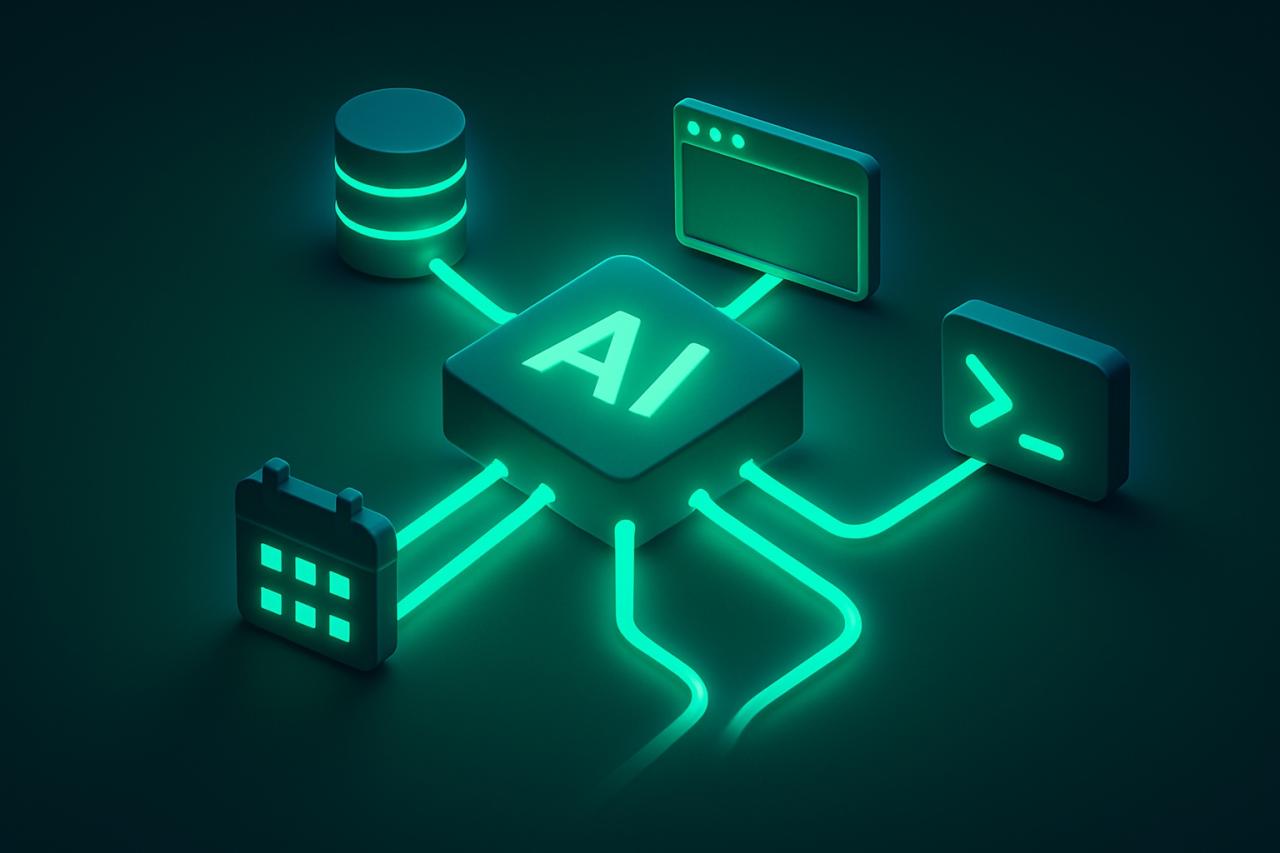 In 2026, "add AI" increasingly means "build an agent" — a model that uses tools, reads your data, and gets work done. The unlock is the Model Context Protocol (MCP), the standard that lets any model talk to any tool. This guide shows you the agent APIs and the MCP plumbing you need to ship one.
AI Agent APIs & the Model Context Protocol (MCP): The 2026 Developer Guide
A chatbot answers. An agent acts — it reads your data, calls your tools, and completes a multi-step task. In 2026 this is the center of gravity for applied AI, and two things made it practical: frontier models that reason and call tools reliably, and a standard that lets any model connect to any tool. That standard is the Model Context Protocol (MCP).
This guide explains MCP, the agent APIs you'll build on, and how the pieces fit.
What is MCP, and why it matters
The Model Context Protocol is an open standard introduced by Anthropic in November 2024 to standardize how AI systems connect to external tools, data, and systems. Think of it as "USB-C for AI tools": instead of writing a bespoke integration per model per tool, you expose a tool once over MCP and every MCP-aware model can use it.
Adoption has been extraordinary:
- OpenAI adopted MCP across the Agents SDK, Responses API, and ChatGPT (from March 2025).
- Google DeepMind and Microsoft shipped support.
- By March 2026, MCP hit ~97 million monthly SDK downloads, with 17,000+ public MCP servers.
- In December 2025, Anthropic donated MCP to the Agentic AI Foundation (Linux Foundation), co-sponsored by OpenAI, Google and Microsoft — turning it from "Anthropic's protocol" into industry infrastructure.
The practical upshot: build your tool integration once over MCP, and it works with Claude, GPT-5.5, Gemini, and the rest.
The anatomy of an agent
- A reasoning model — the brain (GPT-5.5, Claude Opus 4.8, Gemini 3.1 Pro).
- Tools — functions and MCP servers the agent can call.
- Memory / state — short-term context and long-term storage.
- An orchestration loop — plan → act → observe → repeat, with stopping conditions.
- Guardrails — permissions, validation, and human-in-the-loop checkpoints.
Agent APIs and frameworks
OpenAI Agents SDK + Responses API
OpenAI's Responses API unifies model calls, tools, and state, and the Agents SDK layers orchestration on top — including native MCP support.
from openai import OpenAI
client = OpenAI()

resp = client.responses.create(
    model="gpt-5.5",
    input="Find our overdue invoices and draft reminder emails.",
    tools=[{"type": "mcp", "server_label": "billing", "server_url": "https://mcp.internal/billing"}]
)
Anthropic Claude
Claude pairs strong agentic reasoning with native tool use and MCP. The Claude Agent SDK and Claude's long context make it a favorite for coding and document agents.
LangGraph
LangGraph adds a graph-based state machine over LLM calls — explicit nodes, edges, state, and human-in-the-loop checkpoints. Reach for it when control flow gets complex.
CrewAI
CrewAI structures multi-agent systems: define roles ("researcher," "writer," "reviewer") and let them collaborate on a task.
A minimal tool-using agent loop
from openai import OpenAI
client = OpenAI()

def run_agent(goal, tools, tool_impls, max_steps=8):
    messages = [{"role": "user", "content": goal}]
    for _ in range(max_steps):
        r = client.responses.create(model="gpt-5.5", input=messages, tools=tools)
        calls = [o for o in r.output if o.type == "function_call"]
        if not calls:
            return r.output_text
        for c in calls:
            result = tool_impls[c.name](**c.arguments)
            messages.append({"role": "tool", "tool_call_id": c.id, "content": str(result)})
    return "Reached step limit."
Choosing your agent stack
| Need | Pick |
|---|---|
| Tightest model + tool integration | OpenAI Agents SDK + Responses |
| Best long-context coding agent | Claude + Claude Agent SDK |
| Complex branching workflows | LangGraph |
| Multi-agent collaboration | CrewAI |
| Connect any model to any tool | MCP (all of the above) |
Best practices
- Expose tools over MCP so you're not locked to one model.
- Constrain the loop — step limits, budgets, and clear stop conditions prevent runaways.
- Use structured output for every tool call and final answer.
- Add human checkpoints for irreversible actions.
- Log every step — agents are only debuggable if you can replay their reasoning.
- Ground in your data with retrieval — see our embeddings & RAG guide.
Explore agent-ready models and tools in our AI API directory.